Query Optimizer: Building Execution from Lego Blocks
Concept. The query optimizer transforms a SQL query into an executable plan by enumerating possible join orders and access paths, estimating each one's IO cost, and picking the cheapest.
Intuition. For a 3-table join (Users, Listens, Songs) there are six possible join orders and dozens of access paths (full scan vs index scan, hash join vs nested loop). The optimizer asks "what does each cost?" using statistics, then runs the winning plan. A 100× speedup over the naive ordering is normal.
The Journey: SQL to a Plan

Figure 1. SQL is declarative: it states the result, not the procedure. Parsing and binding produce a validated tree; the logical plan then applies equivalence-preserving relational-algebra rewrites (predicate pushdown, projection pruning, subquery flattening). "Defines the result" means exactly this: every rewrite, and every plan the next stage considers, returns the same rows, so the answer is now pinned and only running time can still change. The physical-plan cost search decides speed: it chooses a join order, join algorithm, and access path, and because trying all n! orders is infeasible it uses dynamic programming, computing the cheapest sub-plan for each subset of tables once and reusing it (so n! work collapses to about 2ⁿ), with each candidate costed from table statistics. Only the winner executes, routinely about 100 times faster than the naive ordering.
Algorithm Lego Blocks
The optimizer's job is to pick from a catalog of algorithm "blocks" and assemble them into a physical plan. Four families:
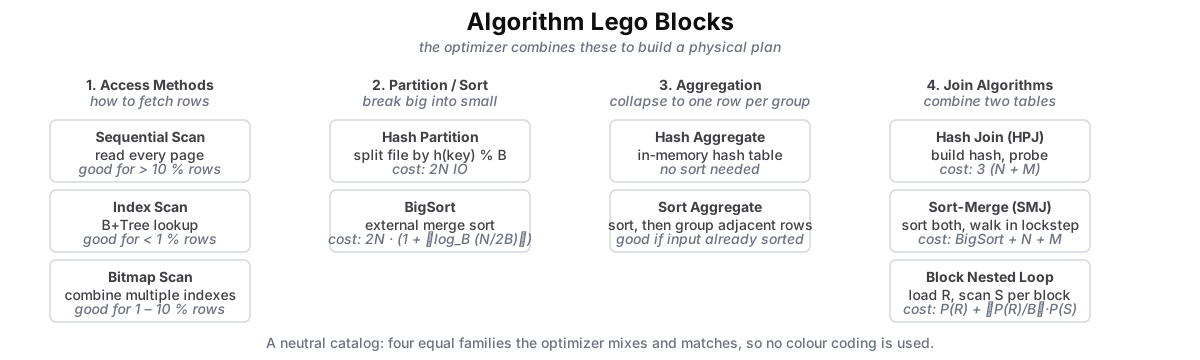
Figure 2. The optimizer assembles a physical plan from four families of interchangeable blocks: access methods (sequential, index, and bitmap scans), partition and sort (Hash Partition, BigSort), aggregation (Hash Aggregate, Sort Aggregate), and join algorithms (Hash Join, Sort-Merge Join, Block Nested Loop). Any plan is just one choice from each family wired together. Each block is a primitive studied on its own page, so plan selection is really a cost comparison across these combinations.
Cost mechanics (how the optimizer picks among these) live in Selectivity & Statistics and IO Cost Summary.
When the optimizer is wrong: stale statistics. If pg_class.reltuples says Listens has 1,000 rows when it actually has a billion, the optimizer picks a plan tuned for small data, runs it on big data, and your query takes hours. The fix in production is almost always ANALYZE, which refreshes the statistics. Most slow queries in the world come down to stale stats, not bad SQL.
Next: Selectivity & Statistics covers how the optimizer estimates the cost of each plan it considers.