Problems: IO Cost Model
Reference
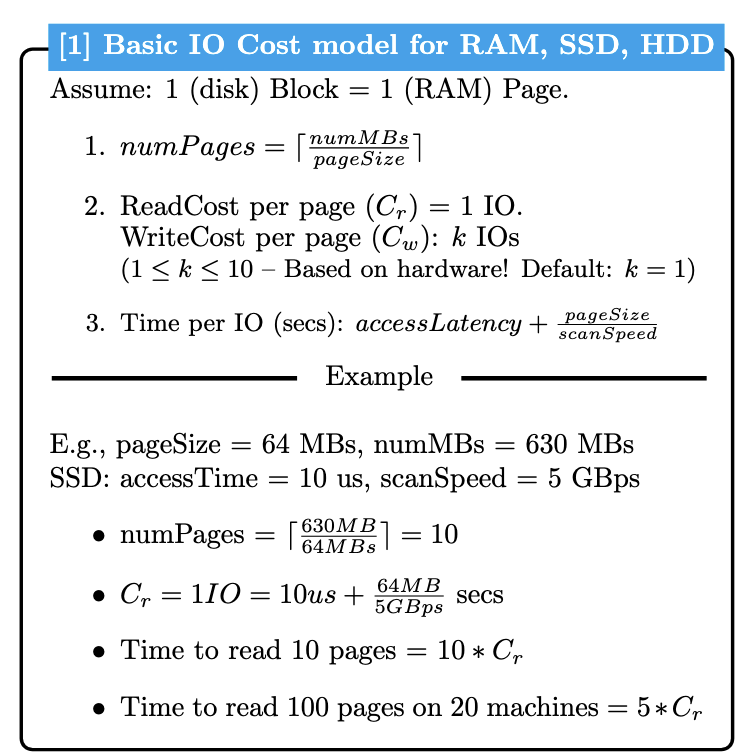
For the official formulas and notation, check the IO Reference Sheet.
Setup
System Configuration:
-
Page Size: 64 MB
-
Spotify Songs Table: 500 million rows × 1024 bytes/row
-
Formulas and Device Specs: Refer to the IO Reference Sheet for C_r/C_w formulas
Quick Reference (64MB pages):
| Device | C_r = C_w | Access + Transfer |
|---|---|---|
| RAM | 0.00064s | 100ns + 64MB/100GB/s |
| SSD | 0.01281s | 10μs + 64MB/5GB/s |
| HDD | 0.65s | 10ms + 64MB/100MB/s |
| Network | 0.00641s | 1μs + 64MB/10GB/s |
Problem 1: Table Size Calculation
The Spotify Songs table has 500 million rows with an average row size of 1024 bytes. Calculate:
-
Total size in MB
-
Number of 64 MB pages needed
🔍 Show Solution
Step 1: Calculate Total Size
Total Size = NumRows × RowSize
         = 500,000,000 × 1024 bytes
         = 512,000,000,000 bytes
         = 512,000,000,000 / 1,000,000 MB
         = 512,000 MB = 512 GB
Step 2: Calculate Number of Pages
numPages = Total Size / Page Size
        = 512,000 MB / 64 MB
        = 8,000 pages
Answer
✅ Size: 512,000 MB (512 GB) | numPages: 8,000
Problem 2: Read Cost Comparison
Calculate the time (in seconds) to read 100 pages from different storage devices.
🔍 Show Solution
For Each Device:
Cost = numPages × C_r where C_r includes both access time and transfer time: C_r = Access Time + PageSize / Scan Speed
RAM:
Cost = numPages × C_r = 100 × (100×10⁻⁹ + 64MB/100GB/s)
     = 100 × (0.0000001 + 0.00064)
     = 100 × 0.0006401
     = 0.064 seconds
SSD:
Cost = numPages × C_r = 100 × (10×10⁻⁶ + 64MB/5GB/s)
     = 100 × (0.00001 + 0.0128)
     = 100 × 0.01281
     = 1.281 seconds
HDD:
Cost = numPages × C_r = 100 × (10×10⁻³ + 64MB/100MB/s)
     = 100 × (0.01 + 0.64)
     = 100 × 0.65
     = 65 seconds
Answer
| Device | Time (seconds) | Relative Speed |
|---|---|---|
| RAM | 0.064 | 1× (fastest) |
| SSD | 1.281 | 20× slower |
| HDD | 65.0 | 1,016× slower |
Problem 3: Cache Hit Rate Impact
You need to read 200 pages with the following cache hierarchy:
-
Check RAM first for all pages (90% hit rate)
-
For RAM misses (10%): 75% found in SSD, 25% in HDD
Calculate the total read time, including the cost of checking RAM.
🔍 Show Solution
Step 1: Check RAM for ALL pages
Must check RAM for all 200 pages to determine hits/misses
RAM Check Cost = numPages × C_r = 200 × (100ns + 64MB/100GB/s)
               = 200 × 0.00064 = 0.128 seconds

Results: 180 pages found (90% hit), 20 pages miss (10%)
Step 2: Fetch misses from lower levels
Of the 20 misses:
  → 15 pages (75%) found in SSD
  → 5 pages (25%) found in HDD

SSD Fetch Cost = numPages × C_r = 15 × (10μs + 64MB/5GB/s)
               = 15 × 0.01281 = 0.192 seconds

HDD Fetch Cost = numPages × C_r = 5 × (10ms + 64MB/100MB/s)
               = 5 × 0.65 = 3.25 seconds
Step 3: Total Cost
Total = RAM Check + SSD Fetch + HDD Fetch
      = 0.128 + 0.192 + 3.25 = 3.57 seconds
Answer
✅ Total time: 3.57 seconds
Key Insights:
-
You ALWAYS pay the cost to check RAM for all pages - this is how caching works!
-
Even with 90% cache hit rate, the 2.5% that goes to HDD (5 out of 200 pages) dominates the total cost!
Problem 4: Mixed Read/Write Operations
You need to:
-
Read 30 pages
-
Write 10 pages
Calculate total cost for each storage device.
🔍 Show Solution
Cost Formula
For mixed operations, calculate each separately:
Total = Read Cost + Write Cost
      = numPages(read) × C_r + numPages(write) × C_w
      = 30 × C_r + 10 × C_w
Since read and write costs are equal for these devices: C_r = C_w
Total = (30 + 10) × C_r = 40 × C_r
RAM:
Cost = 40 × C_r = 40 × 0.00064s = 0.026 seconds
SSD:
Cost = 40 × C_r = 40 × 0.01281s = 0.512 seconds
HDD:
Cost = 40 × C_r = 40 × 0.65s = 26 seconds
Problem 5: Network vs Local Storage
Compare reading 1 page from:
-
Local RAM
-
Local SSD
-
Local HDD
-
Network RAM (RAM on another machine)
🔍 Show Solution
Local Storage Costs
Local RAM:
Cost = numPages × C_r = 1 × (100ns + 64MB/100GB/s)
     = 1 × (0.0000001s + 0.00064s)
     = 0.0006401 seconds
Local SSD:
Cost = numPages × C_r = 1 × (10μs + 64MB/5GB/s)
     = 1 × (0.00001s + 0.0128s)
     = 0.01281 seconds
Local HDD:
Cost = numPages × C_r = 1 × (10ms + 64MB/100MB/s)
     = 1 × (0.01s + 0.64s)
     = 0.65 seconds
Network RAM Cost
Three steps: Read from remote RAM → Network transfer → Write to local RAM
Remote RAM read:  numPages × C_r = 1 × 0.0006401 = 0.0006401 seconds
Network transfer: numPages × C_network = 1 × (1μs + 64MB/10GB/s)
                = 1 × (0.000001 + 0.0064) = 0.006401 seconds
Local RAM write:  numPages × C_w = 1 × 0.0006401 = 0.0006401 seconds
Total:           0.0006401 + 0.006401 + 0.0006401 = 0.0076812 seconds
Answer
| Storage Type | Time (seconds) | Relative to Local RAM |
|---|---|---|
| Local RAM | 0.00064 | 1× (baseline) |
| Network RAM | 0.0077 | 12× slower |
| Local SSD | 0.0128 | 20× slower |
| Local HDD | 0.65 | 1,016× slower |
Key Insight: With modern 10GB/s networks, Network RAM is faster than Local SSD! This is why distributed caching works so well.
Key Takeaways
-
HDDs and SSDs are much slower than RAM for random access
-
Cache hit rates matter enormously - even 5% HDD access can dominate
-
Network RAM ≈ Local SSD in performance
-
Page size affects random access penalty - larger pages amortize seek cost
-
Moving forward: We'll count IOs (1 page = 1 IO) to analyze algorithm complexity