Building Transactions: A Preview
How Do Databases Handle Concurrent Requests? 🍽️
Imagine you're at a busy restaurant where your 10 friends all place their orders at exactly the same time. Each order involves multiple steps: checking ingredients, preparing food, plating, and serving.
How does the kitchen handle this efficiently while ensuring each person gets exactly what they ordered?
The Kitchen Analogy

The Challenge: 10 Orders at Once
Option 1: One Order at a Time (Serial)
🔒 Complete Isolation
Process:
- Take Order #1 → Prepare completely → Serve
- Take Order #2 → Prepare completely → Serve
- Continue until all 10 orders done
✅ Pros
- No confusion or mix-ups
- Easy to manage
- Guaranteed correctness
❌ Cons
- Very slow (10x longer!)
- Kitchen staff idle most of the time
- Customers wait unnecessarily
Option 2: Smart Interleaving (Concurrent)
⚡ Optimized Efficiency
Process:
- Start drinks for all orders (fast step)
- Put fries in fryer for multiple orders
- Grill burgers while fries cook
- Assemble orders as components finish
✅ Pros
- Much faster overall
- Efficient resource usage
- Better customer experience
⚠️ Challenges
- Risk of mixing up orders
- Complex coordination needed
- Need careful tracking
The Key Insight: Isolation Guarantee
🎯 Each Customer's Expectation
Regardless of how the kitchen works internally, every customer must receive their complete, correct order — as if they were the only customer being served.
✅ Good Isolation
Alice orders a burger and fries. She gets exactly her burger and fries, even though the kitchen prepared drinks for 5 other customers while her fries were cooking.
❌ Broken Isolation
Alice's fries accidentally go to Bob's order. Now Alice is missing fries and Bob has extra fries he didn't order.
The Database Version: Transaction Manager
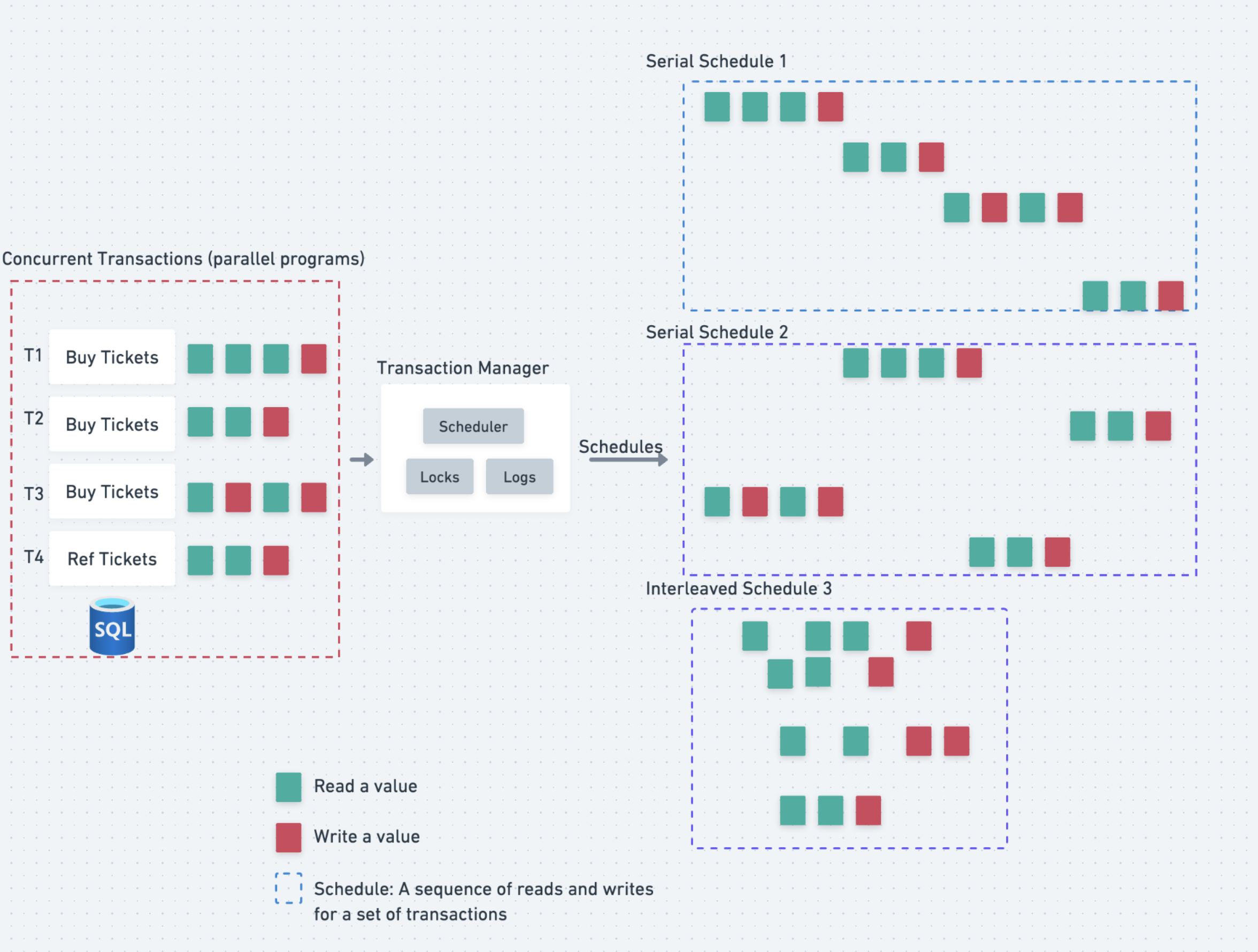
The Three Types of Schedules
📋 Serial Schedule 1
Complete Transaction 1, then Transaction 2, then Transaction 3...
T2: ████
T3: ████
Safe but slow
📋 Serial Schedule 2
Different order: Transaction 2, then Transaction 1, then Transaction 3...
T1: ████
T3: ████
Also safe but slow
⚡ Interleaved Schedule
Mix operations from different transactions smartly
Fast if done correctly
What's Coming Next? 🗺️
The Journey Ahead
🏗️ Foundation
ACID Properties
The four guarantees every transaction needs: Atomicity, Consistency, Isolation, Durability
💭 "What promises do we make to users?"
🔀 Concurrency Control
Isolation in Practice
How to allow interleaving without breaking isolation: Locks, Timestamps, Snapshot Isolation
💭 "How do we coordinate multiple transactions?"
🔄 Recovery
When Things Go Wrong
How to guarantee durability even when systems crash: Write-Ahead Logging, Checkpointing
💭 "How do we survive failures?"
🌐 Distributed Transactions
Multiple Databases
Coordinating transactions across multiple systems: Two-Phase Commit, Consensus
💭 "What about multiple restaurants in a chain?"
The Challenge Ahead
🤔 The Million-Dollar Question
How can we be ultra-fast while maintaining perfect correctness?
This is what transaction processing is all about.