Where's the Next 100x? 🚀
🔄 Beyond 2PL: Rethinking Concurrency
Two-Phase Locking is just one approach in a vast space of possibilities. The next 100x performance gain comes from fundamentally different architectures.
Explore non-locking systems, timestamp ordering, and micro-granularity approaches that break traditional barriers.
The Opportunity Space 📊
Most schedules in the real world aren't conflict-serializable under 2PL - but there are MANY more valid schedules we can safely execute!
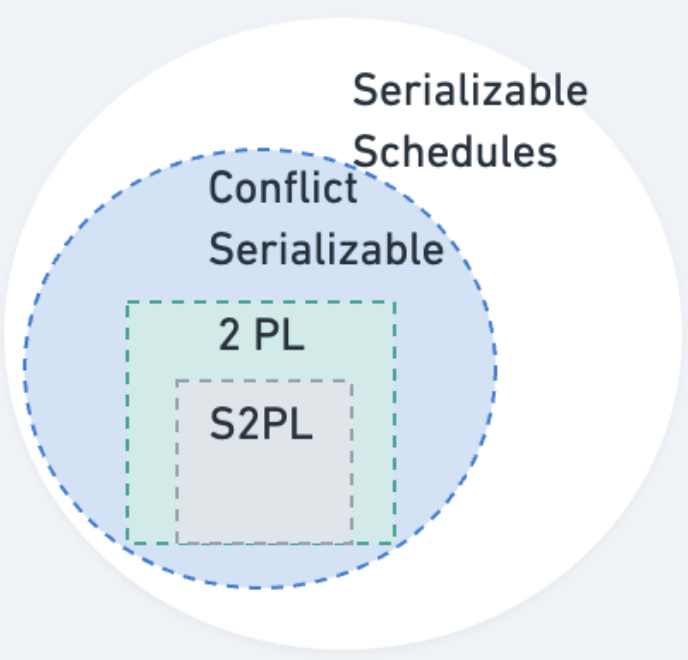
The blue and white areas represent untapped potential - valid, safe schedules that current locking systems don't generate.
Three Paths to the Next 100x 🛣️
🔬 Micro-Locking: Surgical Precision
• Fine-grained locks on specific data elements
• Lock only exactly what you need
• Advanced deadlock detection algorithms
• Hierarchical locking for scalability
Trade-off: Complex lock management overhead
Best for: High-contention concurrent systems
🌲 LSM-Tree Approach: No Locks Needed
• Append-only writes to immutable structures
• No update-in-place operations
• Background compaction merges data
• Reads from multiple levels
Performance: Unlimited write throughput
Trade-off: Eventually consistent reads
Best for: Write-heavy workloads (logs, time-series, IoT)
⏰ Timestamp Ordering: Global Sequencing
• Assign unique timestamps to all operations
• Execute operations in timestamp order
• Abort conflicts, not wait for locks
• Deterministic without coordination
Trade-off: May abort late operations
Best for: Distributed systems, global ordering needs
Choosing Your Path 🎯
📊 For Analytics Workloads
Use LSM Trees or columnar stores. Append-only writes with background compaction eliminate lock contention entirely.
🌐 For Distributed Systems
Use Timestamp Ordering with vector clocks. Global ordering without distributed locking protocols.
💰 For High-Value Transactions
Use Micro-Locking with sophisticated deadlock detection. Maximum concurrency with safety guarantees.
Interview Gold: 3 Real-World Problems
One line: When you see "high write throughput," "global coordination," or "fine-grained contention," think beyond 2PL to these architectural alternatives.
📱 TikTok's Viral Video Storm
Performance: 10M ops/sec on single entity, 99.9% concurrency vs 0.01% with entity locks
Why: Entity-level lock = 1 operation at a time. Field-level locks = 4 operations in parallel. Atomic counters eliminate locks entirely for simple increments.
🎵 Spotify's Play Counter Chaos
Performance: 500K writes/sec, 50ms lag for exact counts, unlimited throughput
Why: 2PL would serialize all counter updates. 10M concurrent incrementers = 10M lock waits vs append-only writes that never conflict.
🤖 AI Agent Collaboration Platform
Performance: 1M operations/sec, 5% abort rate, deterministic results
Why: 2PL with 10K agents creates circular wait chains. Global timestamp ordering eliminates deadlocks - conflicts resolve by "first timestamp wins" rule.