Connecting It All Together
Implementation Motivation 🎯
Now that we understand the theory, let's see how everything connects to build real transaction systems.
The Goal: Implement 2PL locking (or S2PL) to produce conflict-serializable schedules and get big speedups over serial schedules.
The Key Theorem
🔐 2PL Guarantees Conflict-Serializability
One Simple Rule: Once you release any lock, you can't acquire new ones.
The Intuition:
2PL forces all conflicts between two transactions to go in the same direction.
If T1 and T2 conflict on multiple items, under 2PL either:
• T1 completes all its work first (gets all locks, releases them) → T1 → T2 for ALL conflicts
• T2 completes all its work first → T2 → T1 for ALL conflicts
• They interleave, but the first to release becomes "done" → consistent ordering
Result: Can't have T1 → T2 AND T2 → T1 = No cycles!
2PL forces all conflicts between two transactions to go in the same direction.
If T1 and T2 conflict on multiple items, under 2PL either:
• T1 completes all its work first (gets all locks, releases them) → T1 → T2 for ALL conflicts
• T2 completes all its work first → T2 → T1 for ALL conflicts
• They interleave, but the first to release becomes "done" → consistent ordering
Result: Can't have T1 → T2 AND T2 → T1 = No cycles!
Implementation: S2PL in Practice
Sample Code for S2PL
# S2PL Implementation Pattern (Python pseudocode)
class TRANSACTION:
    def __init__(self, transaction_id):
        self.id = transaction_id
        self.locks_held = SET()
        self.state = "ACTIVE"

    def read(self, data_item):
        # Acquire shared lock
        lock_manager.acquire_lock(self.id, data_item, "SHARED")
        self.locks_held.add((data_item, "SHARED"))

        # Perform read
        value = database.read(data_item)
        return value

    def write(self, data_item, value):
        # Acquire exclusive lock
        lock_manager.acquire_lock(self.id, data_item, "EXCLUSIVE")
        self.locks_held.add((data_item, "EXCLUSIVE"))

        # Perform write
        database.write(data_item, value)

    def COMMIT(self):
        # S2PL: Release ALL locks at COMMIT
        for data_item, lock_type IN self.locks_held:
            lock_manager.release_lock(self.id, data_item)
        self.locks_held.clear()
        self.state = "COMMITTED"

    def abort(self):
        # ROLLBACK changes (NOT shown)
        # Release ALL locks
        for data_item, lock_type IN self.locks_held:
            lock_manager.release_lock(self.id, data_item)
        self.locks_held.clear()
        self.state = "ABORTED"
Try it yourself: See the full implementation in the Transactions Colab
The Big Picture
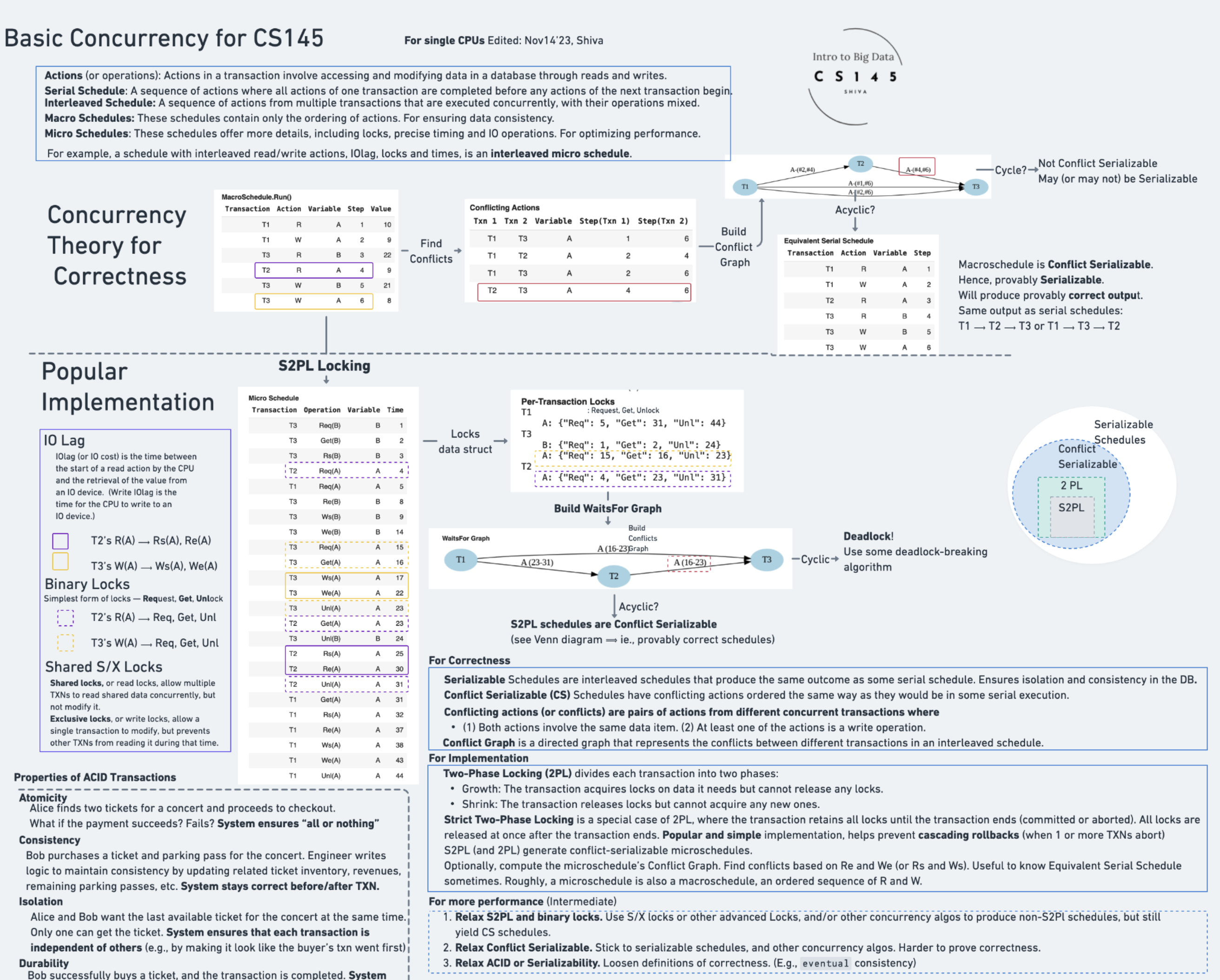
🏗️ Component Integration
How all the pieces work together:
1. Application Layer: Issues transactions
2. Transaction Manager: Coordinates execution
3. Lock Manager: Enforces 2PL protocol
4. Scheduler: Creates conflict-serializable schedules
5. Recovery Manager: Ensures durability
All working together to provide ACID guarantees!
2. Transaction Manager: Coordinates execution
3. Lock Manager: Enforces 2PL protocol
4. Scheduler: Creates conflict-serializable schedules
5. Recovery Manager: Ensures durability
All working together to provide ACID guarantees!
⚡ Performance Benefits
Why this complexity is worth it:
Serial Execution: 48 time units (our Example 1)
2PL with Interleaving: 31 time units
Speedup: ~35% faster!
At Scale: With 100s of transactions, speedup can be 10-100x
Correctness + Performance = Win-Win
2PL with Interleaving: 31 time units
Speedup: ~35% faster!
At Scale: With 100s of transactions, speedup can be 10-100x
Correctness + Performance = Win-Win
The Power of Transaction Managers: Beyond Simple Locks 🚀
Transaction managers aren't just about local locks - they orchestrate complex operations across space and time at massive scale.
🌐 Distributed Lock Management
2PL works seamlessly across multiple machines and data centers
Example - Global Bank Transfer:
• NY server has account A
• SF server has account B
• Tokyo server has audit logs
Distributed TM coordinates:
• Acquires locks across 3 continents
• Maintains 2PL protocol globally
• Same CS guarantees at planetary scale!
OS locks? Only work within single machine
• NY server has account A
• SF server has account B
• Tokyo server has audit logs
Distributed TM coordinates:
• Acquires locks across 3 continents
• Maintains 2PL protocol globally
• Same CS guarantees at planetary scale!
OS locks? Only work within single machine
📅 Intelligent Lock Planning
TMs can plan and schedule locks hours or days in advance
Example - Data Warehouse:
• 6-hour analytics job knows it needs table X at hour 3
• TM pre-reserves locks, optimizes schedule
• Batch jobs coordinate: "I'll take 2-4pm, you take 4-6pm"
Smart Scheduling:
• Priority transactions get future lock reservations
• System predicts conflicts, adjusts timing
• Load balancing across time zones
OS locks? They're immediate-only, no planning
• 6-hour analytics job knows it needs table X at hour 3
• TM pre-reserves locks, optimizes schedule
• Batch jobs coordinate: "I'll take 2-4pm, you take 4-6pm"
Smart Scheduling:
• Priority transactions get future lock reservations
• System predicts conflicts, adjusts timing
• Load balancing across time zones
OS locks? They're immediate-only, no planning
🌍 Scale & Impact - Powering the World
Same 2PL theory scales from 2 to 2 billion transactions
Where This Runs Today:
• Stock Exchanges: Millions of trades/sec, zero conflicts
• Airlines: 50,000 flights, no double-bookings ever
• Social Networks: Billions of likes/comments, all ACID
• Banking: $5 trillion moved daily, perfect consistency
Performance at Scale:
• Google Spanner: 10M QPS across 5 continents
• AWS Aurora: 5x faster than MySQL
• Your CS theory → Trillions in commerce
The Magic: Conflict-Serializability theory you learned powers the global economy!
• Stock Exchanges: Millions of trades/sec, zero conflicts
• Airlines: 50,000 flights, no double-bookings ever
• Social Networks: Billions of likes/comments, all ACID
• Banking: $5 trillion moved daily, perfect consistency
Performance at Scale:
• Google Spanner: 10M QPS across 5 continents
• AWS Aurora: 5x faster than MySQL
• Your CS theory → Trillions in commerce
The Magic: Conflict-Serializability theory you learned powers the global economy!
Summary: From Theory to Practice
🎯 Key Takeaways
Theory Foundation: Conflict-serializability ensures correctness
Implementation: 2PL/S2PL protocols enforce CS schedules
Result: Safe concurrent execution with massive speedups